Carbon Molecular Sieve: Material Optimization to System Energy Efficiency
Time:2026-08-18
Since its inception in the mid-20th century, pressure swing adsorption (PSA) nitrogen production technology has played a pivotal role in the field of industrial gas separation. As the core adsorbent material of this technology, Carbon Molecular Sieve (CMS) directly determines the nitrogen production efficiency, energy consumption level, and operating costs of the nitrogen production system based on its performance. In recent years, with the continuous breakthroughs in materials science, preparation technology, and intelligent control technology, carbon molecular sieves are undergoing a profound transformation from "industrial consumables" to "high-tech functional materials". Today we will systematically analyze the evolutionary logic of carbon molecular sieves from the dimensions of their technical properties, performance indicators, application scenarios, and efficiency upgrade paths.
1、Core technical attributes of carbon molecular sieve
Carbon molecular sieve is a new type of non-polar carbonaceous adsorbent developed in the 1970s, mainly composed of elemental carbon, with a black columnar solid appearance. Its most prominent feature is the highly developed microporous structure, with pore sizes ranging from 0.28 to 0.38 nm (approximately 4 angstroms). This pore size range is precisely located between the oxygen molecular dynamic diameter (about 0.346 nm) and the nitrogen molecular dynamic diameter (about 0.364 nm), enabling carbon molecular sieves to achieve precise molecular sieving at the dynamic level.
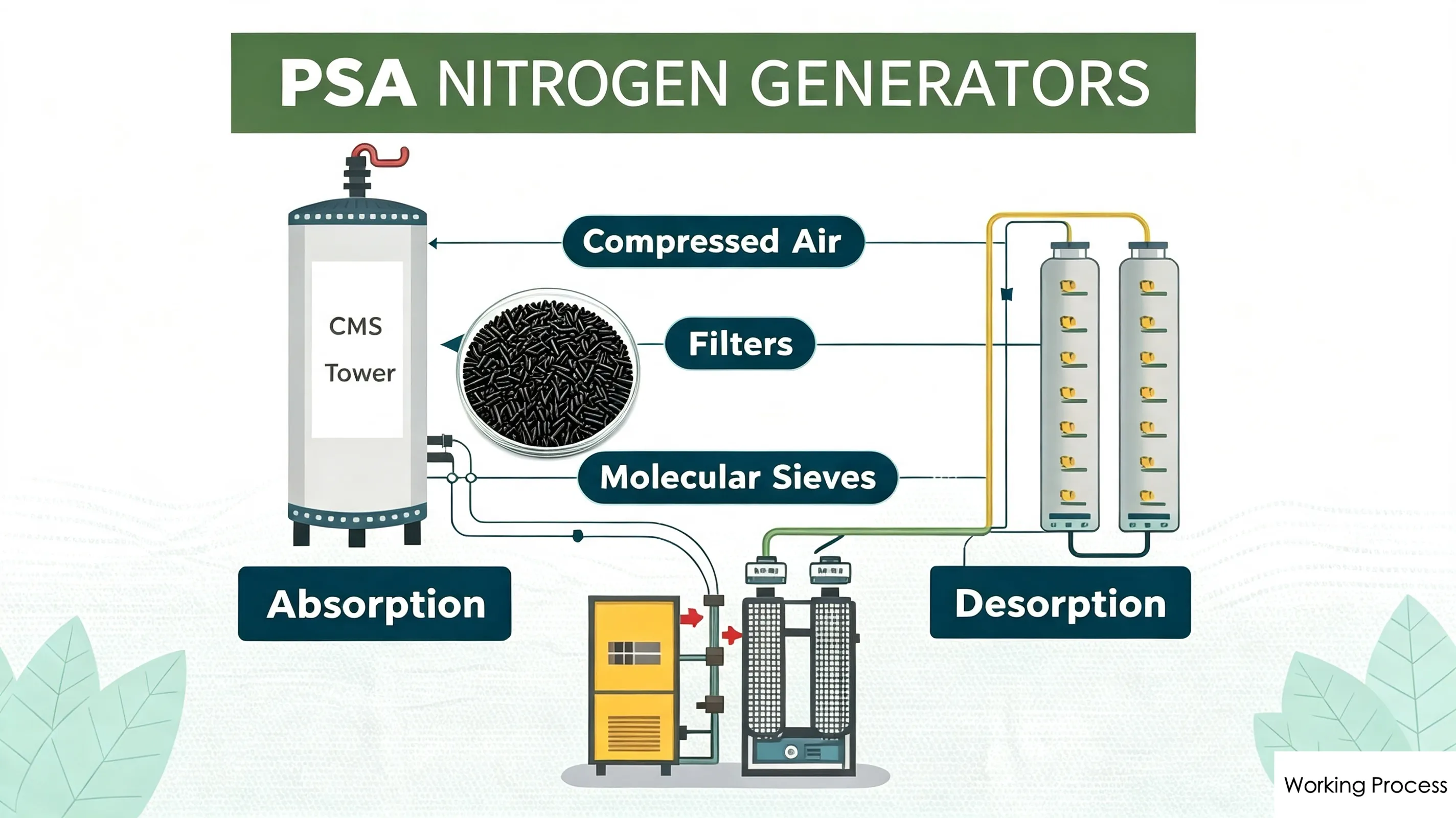
Specifically, under pressurized conditions, smaller oxygen molecules diffuse much faster than nitrogen molecules and are preferentially adsorbed into micropores; And nitrogen molecules, due to their slow diffusion rate, are able to pass through the adsorption bed as product gas. During decompression, the adsorbed oxygen is desorbed and released, allowing the carbon molecular sieve to regenerate and enter the next cycle. The cyclic process of "pressure adsorption pressure desorption" is the basis for the continuous operation of PSA nitrogen production technology.
The pore structure of carbon molecular sieves is not a single micropore, but a multi-level pore system composed of macropores, mesopores, and micropores. Macropores and mesopores mainly serve as gas transport channels, transporting gas molecules to be separated into micropores and sub micropores, with the latter being the true volume for adsorption. Therefore, in the manufacturing process of carbon molecular sieves, precise control of microporous distribution, especially ensuring that the pore size is concentrated in the range of 0.28 to 0.38 nm, is the key to determining their separation performance.
2、Key performance indicators for efficiency upgrade
The core indicator for measuring the efficiency of carbon molecular sieves is not a single parameter, but a set of interrelated performance data. Understanding these indicators is the foundation for evaluating the effectiveness of material upgrades.
Nitrogen production rate is the most intuitive efficiency indicator, which refers to the amount of nitrogen gas produced per hour per unit weight or unit volume of carbon molecular sieve under standard conditions. The higher the nitrogen production rate, the more molecular sieves can be used to achieve the same gas production rate, and the equipment can be designed more compactly with lower investment costs. The purity and recovery rate of nitrogen need to be evaluated in combination. The purity reflects the quality level of the product nitrogen - mainstream carbon molecular sieves can achieve adjustable purity of 95%~99.999%; The recovery rate reflects the utilization efficiency of compressed air. In practical applications, the air/nitrogen ratio (energy consumption index) of carbon molecular sieves is usually between 4.5 and 6.5, with lower ratios indicating better energy consumption. On the premise of ensuring the target purity, the higher the recovery rate, the less waste of compressed air, and the lower the operating power consumption.
The crush strength and wear rate determine the service life of carbon molecular sieves. During the PSA nitrogen production process, the pressure inside the adsorption tower varies periodically, and molecular sieves with insufficient strength will quickly pulverize, resulting in an increase in system pressure drop and uneven gas flow distribution, ultimately affecting nitrogen production efficiency. The compressive strength of mainstream products is usually between 50 ~ 95 N/pcs. Low wear rate means that molecular sieves are more durable and can maintain stable separation performance for a long time.
The dynamic adsorption capacity is more practical than the static adsorption capacity - it reflects the actual adsorption capacity of carbon molecular sieves for oxygen under dynamic gas flow conditions, directly related to nitrogen production efficiency and purity stability.
3、Typical application scenarios and efficiency requirements
The application of carbon molecular sieves has covered a wide range of fields from traditional industries to emerging industries, and different scenarios have their own emphasis on efficiency requirements.
* The electronic semiconductor industry has the most stringent requirements for nitrogen purity, requiring ultra-high purity nitrogen for oxygen free environmental protection in chip manufacturing and component packaging processes. In such scenarios, carbon molecular sieves need to maintain stable nitrogen production and recovery rates under extremely high purity conditions, and any performance degradation may lead to a decrease in yield.
* In the chemical and petrochemical fields, nitrogen is used for reactor inerting, pipeline purging, and nitrogen sealing protection of flammable and explosive material storage tanks. In such applications, the oxygen concentration needs to be controlled below 5ppm. The chemical stability of carbon molecular sieves - high temperature resistance (>300 ℃), corrosion resistance (H2S, moisture, etc.) - enables them to maintain long-term stable separation efficiency under harsh working conditions.
* The food industry extends the shelf life of products through nitrogen filled packaging. The proportion of nitrogen in dynamic modified atmosphere packaging can reach 95% ~99.5%, which can extend the shelf life of perishable products such as strawberries by 2 to 3 times. In this scenario, efficiency is more reflected in the gas production cost and equipment start-up speed per unit of energy consumption.
* The manufacturing of lithium batteries in the field of new energy requires maintaining a nitrogen environment (dew point<-40 ℃) in a drying room to reduce residual moisture in the electrode slurry. In the hydrogen energy industry chain, high-purity nitrogen serves as a protective gas for the electrolysis of water to produce hydrogen, preventing catalyst oxidation. These emerging applications have raised higher requirements for the purity stability and long-term reliability of carbon molecular sieves.
In addition, carbon molecular sieves are widely used in metal heat treatment (nitriding, bright light annealing), pharmaceutical packaging, laser cutting/3D printing auxiliary gas, coal mine fire inerting and other fields.
4、The practical path of efficiency upgrading
The improvement of carbon molecular sieve efficiency is not a single dimensional breakthrough, but the result of multi-level collaborative evolution of material preparation, system design, and intelligent control.
At the material level: precise control of pore size and optimization of raw materials. Accurate control of pore size distribution is fundamental to improving separation selectivity. In recent years, researchers have achieved precise control of the pore size of carbon molecular sieves in the sub angstrom scale by regulating the degree of precursor deoxygenation reaction through precise pyrolysis strategies. In terms of raw materials, coconut shell based carbon molecular sieves are receiving increasing attention due to their renewability and higher mechanical strength. Domestic enterprises have broken through the preparation technology of coal based carbon molecular sieves, with an adsorption capacity of 12~15 ml /g, approaching the international advanced level.
System level: Process optimization and energy consumption reduction. At the PSA process end, significant improvements can be made in nitrogen purity, nitrogen production, and nitrogen recovery rate by designing asymmetric middle pressure equalization pipelines, increasing product nitrogen pressurization, and product nitrogen flushing process steps. The new carbon molecular sieve can reduce the electricity consumption of PSA nitrogen production from 0.3 kWh/cubic meter to below 0.2 kWh/cubic meter. By shortening the adsorption cycle to less than 10 seconds and utilizing the instantaneous adsorption properties of carbon molecular sieves, the equipment volume can be reduced by 50% and energy consumption can be reduced by 15%. Overall, the energy consumption of PSA process is only one-third to one-fifth of that of cryogenic air separation.
In summary, the efficiency upgrade of carbon molecular sieves is a product of the deep integration of materials science, process engineering, and intelligent technology. From precise control of pore size at the sub angstrom level, to intelligent PSA cycle timing, and to continuous optimization of energy consumption throughout the entire lifecycle - every improvement in efficiency means lower operating costs, higher nitrogen recovery rates, and wider industrial application possibilities. For adsorbent foreign trade enterprises, a deep understanding of the technical logic and market trends of this efficiency upgrade is not only the foundation for serving customers, but also the key to grasping the pulse of the industry.
Since its inception in the mid-20th century, pressure swing adsorption (PSA) nitrogen production technology has played a pivotal role in the field of industrial gas separation. As the core adsorbent material of this technology, Carbon Molecular Sieve (CMS) directly determines the nitrogen production efficiency, energy consumption level, and operating costs of the nitrogen production system based on its performance. In recent years, with the continuous breakthroughs in materials science, preparation technology, and intelligent control technology, carbon molecular sieves are undergoing a profound transformation from "industrial consumables" to "high-tech functional materials". Today we will systematically analyze the evolutionary logic of carbon molecular sieves from the dimensions of their technical properties, performance indicators, application scenarios, and efficiency upgrade paths.
1、Core technical attributes of carbon molecular sieve
Carbon molecular sieve is a new type of non-polar carbonaceous adsorbent developed in the 1970s, mainly composed of elemental carbon, with a black columnar solid appearance. Its most prominent feature is the highly developed microporous structure, with pore sizes ranging from 0.28 to 0.38 nm (approximately 4 angstroms). This pore size range is precisely located between the oxygen molecular dynamic diameter (about 0.346 nm) and the nitrogen molecular dynamic diameter (about 0.364 nm), enabling carbon molecular sieves to achieve precise molecular sieving at the dynamic level.
Specifically, under pressurized conditions, smaller oxygen molecules diffuse much faster than nitrogen molecules and are preferentially adsorbed into micropores; And nitrogen molecules, due to their slow diffusion rate, are able to pass through the adsorption bed as product gas. During decompression, the adsorbed oxygen is desorbed and released, allowing the carbon molecular sieve to regenerate and enter the next cycle. The cyclic process of "pressure adsorption pressure desorption" is the basis for the continuous operation of PSA nitrogen production technology.
The pore structure of carbon molecular sieves is not a single micropore, but a multi-level pore system composed of macropores, mesopores, and micropores. Macropores and mesopores mainly serve as gas transport channels, transporting gas molecules to be separated into micropores and sub micropores, with the latter being the true volume for adsorption. Therefore, in the manufacturing process of carbon molecular sieves, precise control of microporous distribution, especially ensuring that the pore size is concentrated in the range of 0.28 to 0.38 nm, is the key to determining their separation performance.
2、Key performance indicators for efficiency upgrade
The core indicator for measuring the efficiency of carbon molecular sieves is not a single parameter, but a set of interrelated performance data. Understanding these indicators is the foundation for evaluating the effectiveness of material upgrades.
Nitrogen production rate is the most intuitive efficiency indicator, which refers to the amount of nitrogen gas produced per hour per unit weight or unit volume of carbon molecular sieve under standard conditions. The higher the nitrogen production rate, the more molecular sieves can be used to achieve the same gas production rate, and the equipment can be designed more compactly with lower investment costs. The purity and recovery rate of nitrogen need to be evaluated in combination. The purity reflects the quality level of the product nitrogen - mainstream carbon molecular sieves can achieve adjustable purity of 95%~99.999%; The recovery rate reflects the utilization efficiency of compressed air. In practical applications, the air/nitrogen ratio (energy consumption index) of carbon molecular sieves is usually between 4.5 and 6.5, with lower ratios indicating better energy consumption. On the premise of ensuring the target purity, the higher the recovery rate, the less waste of compressed air, and the lower the operating power consumption.
The crush strength and wear rate determine the service life of carbon molecular sieves. During the PSA nitrogen production process, the pressure inside the adsorption tower varies periodically, and molecular sieves with insufficient strength will quickly pulverize, resulting in an increase in system pressure drop and uneven gas flow distribution, ultimately affecting nitrogen production efficiency. The compressive strength of mainstream products is usually between 50 ~ 95 N/pcs. Low wear rate means that molecular sieves are more durable and can maintain stable separation performance for a long time.
The dynamic adsorption capacity is more practical than the static adsorption capacity - it reflects the actual adsorption capacity of carbon molecular sieves for oxygen under dynamic gas flow conditions, directly related to nitrogen production efficiency and purity stability.
3、Typical application scenarios and efficiency requirements
The application of carbon molecular sieves has covered a wide range of fields from traditional industries to emerging industries, and different scenarios have their own emphasis on efficiency requirements.
* The electronic semiconductor industry has the most stringent requirements for nitrogen purity, requiring ultra-high purity nitrogen for oxygen free environmental protection in chip manufacturing and component packaging processes. In such scenarios, carbon molecular sieves need to maintain stable nitrogen production and recovery rates under extremely high purity conditions, and any performance degradation may lead to a decrease in yield.
* In the chemical and petrochemical fields, nitrogen is used for reactor inerting, pipeline purging, and nitrogen sealing protection of flammable and explosive material storage tanks. In such applications, the oxygen concentration needs to be controlled below 5ppm. The chemical stability of carbon molecular sieves - high temperature resistance (>300 ℃), corrosion resistance (H2S, moisture, etc.) - enables them to maintain long-term stable separation efficiency under harsh working conditions.
* The food industry extends the shelf life of products through nitrogen filled packaging. The proportion of nitrogen in dynamic modified atmosphere packaging can reach 95% ~99.5%, which can extend the shelf life of perishable products such as strawberries by 2 to 3 times. In this scenario, efficiency is more reflected in the gas production cost and equipment start-up speed per unit of energy consumption.
* The manufacturing of lithium batteries in the field of new energy requires maintaining a nitrogen environment (dew point<-40 ℃) in a drying room to reduce residual moisture in the electrode slurry. In the hydrogen energy industry chain, high-purity nitrogen serves as a protective gas for the electrolysis of water to produce hydrogen, preventing catalyst oxidation. These emerging applications have raised higher requirements for the purity stability and long-term reliability of carbon molecular sieves.
In addition, carbon molecular sieves are widely used in metal heat treatment (nitriding, bright light annealing), pharmaceutical packaging, laser cutting/3D printing auxiliary gas, coal mine fire inerting and other fields.
4、The practical path of efficiency upgrading
The improvement of carbon molecular sieve efficiency is not a single dimensional breakthrough, but the result of multi-level collaborative evolution of material preparation, system design, and intelligent control.
At the material level: precise control of pore size and optimization of raw materials. Accurate control of pore size distribution is fundamental to improving separation selectivity. In recent years, researchers have achieved precise control of the pore size of carbon molecular sieves in the sub angstrom scale by regulating the degree of precursor deoxygenation reaction through precise pyrolysis strategies. In terms of raw materials, coconut shell based carbon molecular sieves are receiving increasing attention due to their renewability and higher mechanical strength. Domestic enterprises have broken through the preparation technology of coal based carbon molecular sieves, with an adsorption capacity of 12~15 ml /g, approaching the international advanced level.
System level: Process optimization and energy consumption reduction. At the PSA process end, significant improvements can be made in nitrogen purity, nitrogen production, and nitrogen recovery rate by designing asymmetric middle pressure equalization pipelines, increasing product nitrogen pressurization, and product nitrogen flushing process steps. The new carbon molecular sieve can reduce the electricity consumption of PSA nitrogen production from 0.3 kWh/cubic meter to below 0.2 kWh/cubic meter. By shortening the adsorption cycle to less than 10 seconds and utilizing the instantaneous adsorption properties of carbon molecular sieves, the equipment volume can be reduced by 50% and energy consumption can be reduced by 15%. Overall, the energy consumption of PSA process is only one-third to one-fifth of that of cryogenic air separation.
In summary, the efficiency upgrade of carbon molecular sieves is a product of the deep integration of materials science, process engineering, and intelligent technology. From precise control of pore size at the sub angstrom level, to intelligent PSA cycle timing, and to continuous optimization of energy consumption throughout the entire lifecycle - every improvement in efficiency means lower operating costs, higher nitrogen recovery rates, and wider industrial application possibilities. For adsorbent foreign trade enterprises, a deep understanding of the technical logic and market trends of this efficiency upgrade is not only the foundation for serving customers, but also the key to grasping the pulse of the industry.
